
I created our very first video, “Destroying a $5000 guitar”, designed to initially create some “shock” but with a “purpose” too to create awareness and get attention about the counterfeit guitar market – the hope that people would follow the video and then read the full story here and heed the warnings of this disturbing problem!
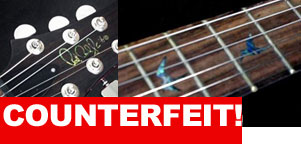 The guitar, as you now know, is (was!) a counterfeit PRS, complete with Paul Reed Smith logo on the headstock, bird inlays and other signature PRS details. The guitar came out of a factory in Korea, and this is just one of many guitars (Gibson and Fender counterfeits exists as well) being copied in factories around the world.
Last year, Gibson issued a press release discussing the counterfeit problem, with tips on how to recognize a genuine vs. counterfeit Gibson. Tips from their press release:
Consumers can check any of the references below when examining a Gibson guitar in an effort to insure its authenticity:
- Make sure the body is not undersized.
- The headstock and headstock logo should match those of authentic Gibson guitars.
- Pearl should always be inlaid on the headstock on standard models.
- Les Paul Model script should always be in cursive.
- If the guitar has a 3-screw truss rod it is not authentic.
- Check the control and pick up cavities for sloppy routing or wiring.
- Real Gibson guitars use one-piece necks.
- Many fake Gibsons have their pickup cavities painted black inside.
- If purchasing a Gibson always ask for the Gibson’s Owner Manual and Gibson/Warranty Inspection Card.
- Check the wiring, if it is plastic it isn’t a true Gibson.
These are helpful tips, but understand that they are not guaranteed rules as counterfeit 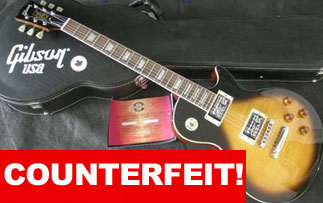 guitars are changing as well. It is not uncommon to find, for example, a Les Paul with what appears to be a “correct” 2-screw truss rod cover, but still is a counterfeit model. Likewise, many counterfeits now include documentation, with “factory labeled” stickers over the pickguards and pickup covers.
The most significant problem with counterfeit guitars occurs when unscrupulous people try to pass them off as being the real thing. Counterfeit guitars, with their cheaper materials and components, wood selection, construction, and setup fit/finish sell for a fraction of the price of real instruments. Opportunities exist for unethical people looking to take advantage of others. This is exactly what happened in a well-documented case last year when Steven F. Sexton was caught by Federal investigators, and then pleaded guilty to selling counterfeit instruments, including to a 15-year old boy.
But even people with awareness of the issue can sometimes be stung with a fake.
Jeremy Wagner, a twenty-five year old web developer based in Minnesota, grew up dreaming of owning his very own Gibson guitar. When he knew the time would be coming soon to be able to buy one, he headed down to a local Guitar Center.
“I tried various makes and models, but I was really captivated when I got my hands on a Gibson SG Standard and an SG ’61 Reissue,” he said. “Both were excellent instruments in every single category. So I began to save up some money in preparation for the day when I’d be able to afford my first Gibson.”
A short while later, he was alerted to a used Gibson SG ’61 reissue that had been posted on Craigslist.
“The photos looked fine, and I knew some stuff about counterfeit Gibsons, but evidently not enough. When I arrived, I was surprised to find out that the seller was my predecessor from my first gig up in the Twin Cities. So I was already possessed of some trust, although he didn’t know he was selling a counterfeit Gibson at the time either. He was selling the instrument for $900: A price that was a really good deal for such an instrument, but didn’t raise my eyebrows. In other words, it wasn’t a deal I would consider to be ‘too good to be true’ even today.
“Perhaps it was because I knew the person that it made me have somewhat of a less critical eye. The truss rod cover was missing, but I checked to make sure that there were two screw holes, since a three-screw truss rod cover is a dead giveaway. Aside from a loose pickup cover on the neck pickup and a bit of finish checking, the guitar was in excellent, playable condition. I handed him a wad of bills and went home as the happy owner of a Gibson SG.”
Jeremy’s elation ultimately went sour after he went to purchase a genuine Gibson replacement truss rod cover. It didn’t fit.
Jeremy’s heart sank further when his suspicion of owning a counterfeit instrument was later confirmed by a local guitar technician. “He gave me a laundry list of reasons for why it was counterfeit. The serial number, although a properly formatted Gibson serial number, was stamped into the wood without having finish applied over it. The weight of the instrument was off. The finish was polyester, not nitrocellulose. The pickup switch hardware and knobs weren’t characteristic of a ’61 reissue. Every reason was another nail in the coffin.”
Jeremy contacted the seller immediately, who confirmed that he didn’t know it was a counterfeit either, and who was also crushed to learn that he was “playing a lie”, as Jeremy describes it. The seller also agreed to work with him to pay him his money back. And the two together began to retrace the earlier sale.
“When the guy who sold it to me had originally purchased it, he e-mailed the seller with his phone number. The seller at that time then called him from a private number and arranged to deliver the guitar to his home. He had effectively created a way to ensure that he was untraceable.”
What remains now is a waiting game.
“We filed a police report to get Craigslist to release the IP and email of the seller, but they won’t release that information unless a warrant is produced.”
Which brings us to the present.
“I’ve got a fake Gibson on my hands, my seller is aiming to refund my money as soon as he can (as he had to spend the money I gave him for the guitar to pay bills), and we’re just waiting to see what the police have to say. In the meantime, I’m saving again for a brand-new Gibson.”
Not everyone is sympathetic to the counterfeiters or their customers. One such purchaser of counterfeit instruments (who declined to be named) stated simply, “Gibson and PRS guitars are too expensive. If I can have a guitar that looks like one, as long as I’m not cheating someone when I go to sell it later, then who cares?”
But the problem with that logic, besides the fact that the purchaser is supporting an illegal industry, is that a future owner down the road may be subject to being ripped off too – if the fact that the acknowledgement of the guitar being a counterfeit is, at some point, “forgotten”.
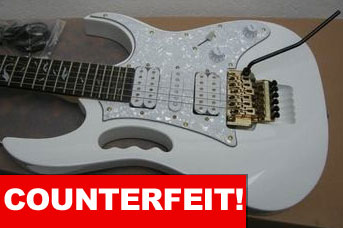
Legendary guitar maestro Steve Vai, whose own signature Ibanez instruments are also seen in inferior-quality counterfeit versions, offers his perspective:
“When someone designs something, such as a particular guitar model or piece of gear, (or anything for that matter) that is accessible and inspiring, it’s not unlikely that it will be copied or used as inspiration for something else. It’s how technology evolves and that’s OK. It’s when something is ripped of to a ‘T’ when things get questionable (Karmic perhaps).”
 So what can buyers do to avoid being hit with a counterfeit instrument? Gibson suggests buying guitars only from authorized dealers, sound advice which certainly applies to other manufacturers as well.
But when purchasing a used instrument, proper education is certainly key, and best to be received by a well-known expert and/or enthusiast. Experts and enthusiasts are often online participating in forums and can help determine an instrument’s legitimacy – and most are happy to help others (which is why they’re on the forum boards to begin with).
Below is a short list of some great forums, many of which I’ve personally participated on:
Fender Forum: www.fenderforum.com
Gibson Forum: http://forums.Gibson.com
Ibanez: www.jemsite.com/forums/index.php
Les Paul Forum: www.lespaulforum.com
PRS Paul Reed Smith Forum: www.prsforums.com
Harmony-Central counterfeit topic forum: http://acapella.harmony-central.com/forums/forumdisplay.php?f=121
Many dealers who sell used and new instruments often become experts over time at identifying fakes, since they essentially must do so in order to protect their own business. Search the web or inquire at the forums about a dealer’s general reputation. Ask the dealers themselves about their policies on returns of instruments discovered to be fake if a personal inspection is not possible (e.g. an online transaction). Don’t accept language from anyone stating anything is legit, “…to the best of my knowledge.” Those are weasel words that enable any seller to save himself from having personal responsibility later on, should a problem arise.
If buying from individuals online or directly in-person, be sure that they’re open with their appropriate contact information and can be traced after the sale if necessary. If it’s Ebay, check their reputation/record and check with others on forums via the photos and links of the guitar offered. Don’t assume the seller of a fake instrument knows that it is a counterfeit. Let them know as a courtesy if you’d like, but be respectful. They may be in shock to learn that the instrument was a fake as well.